
Daoist Rituals
"Daoism Ritual" is a Taoist term referring to religious rituals conducted according to specific procedures and regulations. It is also known as "Zhaijiao," "Fashi," or "Daochang." Keyi involves fixed steps, scriptures, incantations, gestures (such as kowtowing, hand seals, and ritual walking patterns), music, and ritual implements (such as bells, swords, and seals).
Ritual for Dispelling Marital Misfortune and Harmonizing Marriage
is an orthodox Taoist ceremony involving scripture chanting, repentance rites, and blessings to dispel marriage-related afflictions and harmonize destined relationships. Besides harmonization, it can also resolve various marriage-related afflictions such as solitary phoenix, widowed star, salty pool bathing, fiery peach blossoms, entangled marriage afflictions, broken marriage afflictions, bigamy afflictions, divorce afflictions, separated marriage afflictions, peach blossom afflictions, multiple husband afflictions, multiple wife afflictions, well water afflictions, three male afflictions, eight defeats afflictions, solitary and widowed afflictions, and others. Unmarried individuals are encouraged to find their true match as soon as possible; married couples can enhance their marital affection; and those seeking love can hope to unite in matrimony soon.
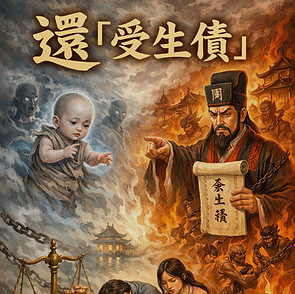
Repaying the "Birth Debt"
Debts of the Underworld (Yin Debt) refer to the obligations borrowed from the underworld officials before a soul reincarnates, as well as the sum total of various debts accumulated across past and present lives. Specific contents include: debts to parents, debts for sustenance, debts for killing, birth debts, debts from miscarriage and abortion, etc.
Among these, the Birth Debt (Shou Sheng Zhai) is the most important item and a debt that must be repaid. There are two interpretations:
-
It is the startup capital a person receives before reincarnation.
-
It is a “life script” you purchase for your time in the mortal world.
In essence, it is the blessing you obtain by borrowing money from the underworld officials (e.g., King Cao) before reincarnation, which then manifests in your earthly life — such as how much food you have, how many clothes you wear, how much money you can use, and how long you have to repay this debt. If these debts are not repaid for a long time, many things in life will not go smoothly.
According to the Lingbao Tianzun’s Scripture on the Treasury of Birth Debts, all sentient beings borrowed birth money from the underworld at the time of birth. The registers of the underworld record that those who repay this money will become wealthy and noble, while those who fail to repay will suffer poverty, as the underworld officials deduct their blessings in the mortal world to offset the debt. Therefore, “repaying the birth debt” — whether for family, friends, or out of goodwill — is the foundation of the debt-repayment ritual. After completing this ritual, other rituals can be performed. It is like laying a solid foundation, making the effects of other practices more favorable.
Why must one repay this birth debt?
The Five Dippers’ Birth Debt Scripture clearly states: before reincarnation, the soul makes a vow in the underworld that, if it becomes human again, it must repay its life’s obligations — i.e., the birth debt. If not repaid, the soul can never reincarnate as a human and must suffer in hell. Even after becoming human, one must still repay the birth debt, but after reincarnation, people forget many things from past lives, and the underworld debts are left behind. Then, out of compassion, the Taishang Laojun’s Scripture of the Five Dippers’ Golden Chapter on Birth Debts reminds us that repaying the birth debt is not only about returning money but is also the key to resolving karma and changing one’s fortune.
What are the benefits after repaying the birth debt?
According to one passage in the Taishang Laojun’s Scripture of the Five Dippers’ Golden Chapter on Birth Debts, those who repay will enjoy safety in travel, success in their wishes, protection from their natal constellation deity, avoid losing their human form after death, be able to reincarnate into a wealthy life, receive the help of civil and wealth stars, and have fivefold blessings with few disasters and difficulties. For those who do not repay, the Lingbao Tianzun’s Scripture on the Treasury Registers says that if one does not believe in past affinities and present dharma, and remains in debt, their name will be recorded in the sin register, their lifespan will be reduced by the Heavenly Court, and after descending to hell, they will undergo countless eons of suffering and become animals. Even if they reincarnate again, they will be poor, lowly, and without any support. Thus, repaying the birth debt is a matter of resolving karma.
Calculation of the Birth Debt
How much birth debt each person needs to repay can be calculated using a relatively simple method:
Divide your current age by 10, take the resulting number (if there is a remainder, add 1), then multiply that multiplier by the corresponding amount of silver money required.
For example, if a devotee is 32 years old this year:
32 ÷ 10 = 3 with a remainder of 2 → remainder exists, so add 1 → 3+1 = 4.
Then multiply the corresponding amount by 4.
It is recommended to use “Jade Emperor Universal Currency” when repaying the birth debt. One piece of Jade Emperor Universal Currency is worth 10,000 strings of cash.

Wenchang Ritual
Wenchang Ritual Lineage
The Wenchang Lord’s ritual lineage can assist with pursuing education, seeking employment, and praying for children.
Vermilion-Robed One Dots the Brush to Open Wisdom Ritual
The Vermilion-Robed Deity is one of the martial Wenchang figures in Daoism, also known as the Vermilion-Robed Elder. Because he wears a red (zhu) robe, he is honored as the Vermilion-Robed Deity. His image is that of a Daoist in a red robe, draped with embroidered patterns, holding a precious letter case in his hands, handling the profound writings of jade resonance, overseeing the ranks of officials, and managing the heavenly roll of the golden gate. He assists Lord Wenchang in spreading transformation through the flying phoenix, and manifests wherever the Phoenix Pool directs. He is in charge of the heavenly examination list and is able to discern the quality of writings—effectively acting as our “examination paper grader.” At the same time, he controls the release of grading results.
Ancient records recount that when Ouyang Xiu served as Hanlin Academician presiding over the examinations at the Imperial Examination Hall, he often felt that a person in a red robe was standing behind him as he graded the papers, observing the brush in his hand. Whenever an excellent essay or passage appeared, this Vermilion-Robed Daoist would nod. At first, Ouyang Xiu thought it was one of his attendants, but when he looked back, there was no one there. Hence a saying has been passed down to this day: “Since ancient times, writings have had no fixed standard; one can only hope for a nod from the Vermilion-Robed One.” After this story spread, later candidates taking examinations would silently pray in their hearts, “I hope the Vermilion-Robed One will nod,” wishing for their examination to be successful. Thus, phrases like “the Vermilion-Robed One nods” and “the Vermilion-Robed One gives the nod” came to be used metaphorically for being favored by the examiner and passing the selection.
Kui Xing Assists Literature and Activates Fortune Ritual
The Kui Xing ritual is most suitable for middle-school entrance exams, college entrance exams, and other competitive assessments (that is, selection-type exams or competitions). It can also be used together with the rituals mentioned earlier. This ritual is best performed close to the time of the exam.
One thing to note when performing the Wenchang ritual is that conducting the ritual is not meant to make you perform exceptionally beyond your ability; rather, it is to help you perform normally, reaching the level you usually achieve. If your usual studies are already lacking, then the ritual can only ensure that you do not feel nervous during the exam, do not fall ill, are free from other distractions, can perform at your normal level, and receive a slight boost in fortune—this is already a good outcome.

Worship Ceremony for Tai Sui
"There are four main parts: Worshipping the Seven Stars, Worshipping the Nine Sovereigns, the Tai Sui Ritual, and a Tai Sui Talisman.
What is Tai Sui?
Tai Sui is a very early method of year reckoning. It uses the 60‑year jiazi cycle, each year having a different combination of Heavenly Stems and Earthly Branches—60 arrangements in total. That is why the “60 Jiazi” correspond to the 60 Tai Sui deities, all called Tai Sui Generals. The Tai Sui General on duty for a given year is the reigning Tai Sui for that year. One can think of him as the “emperor” of the year, because his authority is immense—he oversees all affairs of the human realm, including fortune, misfortune, disasters, and calamities.
Records of Tai Sui worship go back a very long time. Some swindlers claim that Tai Sui worship has no origin and is fake, but that is incorrect. The earliest belief in Tai Sui can be traced back to the end of the Shang dynasty and the beginning of the Zhou dynasty. Western Zhou historical texts contain records related to Tai Sui worship and astrological observation. By the Eastern Han period, Huang–Lao Daoism was flourishing. After the Heavenly Stems and Earthly Branches system became widespread, the Tai Sui deities developed into the 60 Tai Sui Generals, who take turns being on duty, governing human fortunes and misfortunes. From this, the custom of worshipping Tai Sui emerged. Its basic framework took shape during the Song dynasty, and it was finalized in the Qing dynasty. By the Qing dynasty, the names, images, stories, and origins of all Tai Sui deities were definitively established.
Tai Sui is a worship custom our nation has observed since ancient times. What people commonly call “offending Tai Sui” actually refers to four types of Tai Sui conflicts: xing (clash), chong (opposition), po (destruction), and hai (harm).
-
Xing Tai Sui (clash): prone to disputes, career and interpersonal difficulties, possible verbal conflicts or legal troubles.
-
Chong Tai Sui (opposition): major setbacks in life, upheavals in health or career, family discord, etc.
-
Po Tai Sui (destruction): prone to financial loss, falling out with others, business failures.
-
Hai Tai Sui (harm): susceptible to sabotage by rivals, betrayal by friends, family illness, etc.
Tai Sui is an auspicious deity, not a malevolent spirit. Problems arise only because a person’s zodiac sign conflicts with the reigning Tai Sui of the year. The Tai Sui is the “emperor” of the year; the year’s fortune and misfortune are under his dominion. Even if you do not conflict with Tai Sui, you may still worship Tai Sui to pray for safety throughout the year, seeking good fortune and avoiding calamity.
The origins of the Tai Sui rituals compiled in this ritual manual combine popular ritual lineages and the transmissions of folk masters—how to set up the dou (ritual vessel/altar), how to perform the dou rites, and how to pay homage to the Nine Sovereigns.
The Tai Sui Ritual is mainly divided into two parts:
-
How to set up the dou and how to worship the Seven Stars.
-
How to pay homage to the Nine Sovereigns and the Tai Sui Talisman.

Breakthrough Ritual
"Breakthrough Ritual" – The Marshal Yin Ritual is a Taoist ceremonial rite dedicated to Marshal Yin, the commanding general who oversees the Sixty Jiazi Tai Sui deities and the Twelve Yearly Gods. This ritual is primarily used to ward off disasters, resolve Tai Sui conflicts, protect the home and suppress evil spirits, as well as to overcome obstacles and dispel misfortunes.